I can almost see you trying to balance the dream of getting married in Italy with an endless stream of wedding-planning guides, checklists and advice.
Here’s the good news: dreams and serious project management really can coexist in the wedding world.
Your wedding is, in many ways, a beautiful challenge wrapped in pink tulle — with a few very real opportunities to slip along the way.
So consider these the non-slip socks I’m happily handing you: not a magic formula, and certainly not a definitive guide, but seven practical things worth thinking about before some of the bigger decisions begin.
1. The venue price is not your wedding budget
This is probably one of the easiest traps to fall into.
You find a beautiful venue in Italy, receive the rental fee and catering proposal, add the two together and start thinking: Great, now I know roughly what my wedding will cost.
Not quite.
Some of the expenses couples most often underestimate are the ones that are less exciting to imagine: sound and lighting, transportation, guest transfers, rentals and technical services.
And these costs can change enormously depending on the venue.
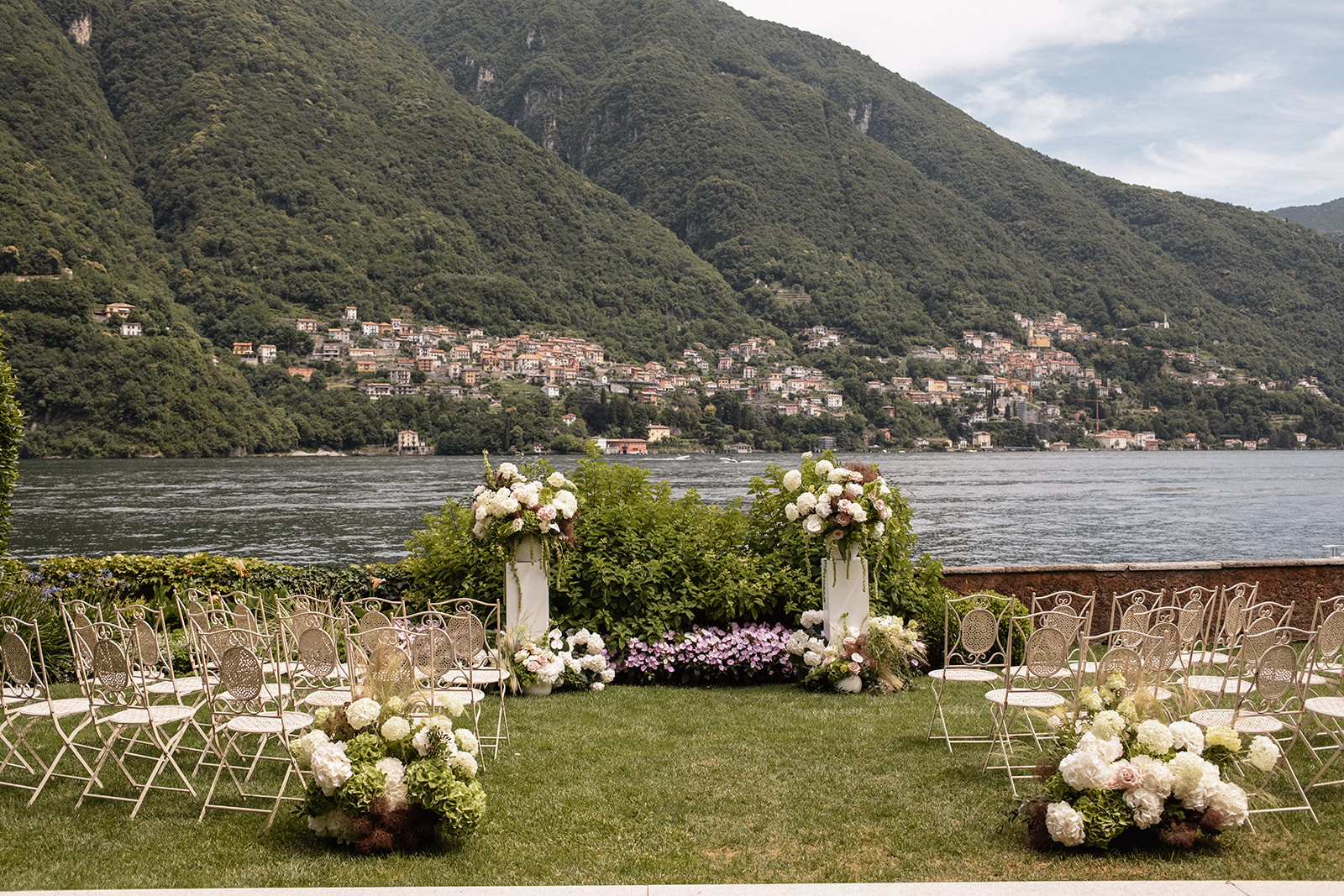
A dinner that looks effortless in a beautiful Italian garden may require additional lighting, an audio system, generators or technical staff.
A spectacular villa overlooking a lake may also require an entire transportation plan for your guests.
Which brings us neatly to the next point.
2. Ten kilometres in Italy may not mean ten easy
When planning from the US, Google Maps can give you a dangerously reassuring impression.
Two places may look very close geographically and still require completely different logistics.
Lake Como is a perfect example.
In Cernobbio, for instance, some hotels and B&Bs are located along roads that can be reached by a normal car but not by a large coach — and sometimes not even by anything bigger than a seven-seater van.
So arranging transportation is not simply:
“We have 70 guests. Let’s book a bus.”
You need to know where each group is staying, which vehicles can physically reach those properties, where guests can be collected, where vehicles can stop and how long each journey will realistically take.
And on the Italian lakes, sometimes the best vehicle isn’t a vehicle at all.
It’s a boat.
3. Italian wedding venues don’t all work in the same way
A beautiful Italian villa is not automatically a fully equipped wedding venue.
This distinction matters enormously.
Some venues provide catering internally. Others require you to choose from an approved list. Some are essentially a beautiful building and a garden, meaning almost everything else must be brought in.
Tables. Chairs. Linen. Kitchen equipment. Lighting. Sound. Staff areas. Sometimes even the infrastructure needed to serve dinner efficiently.
And then there are rules: music curfews, access times for suppliers, setup restrictions, exclusivity requirements, rain plans and catering policies.
Two venues with the same rental price can therefore result in two completely different final wedding budgets.
The important question isn’t simply:
“How much does the venue cost?”
It’s:
“What will we actually need in order to make our wedding work in this venue?”
4. VAT, deposits and payment schedules deserve your attention
This may not be the part of Italian wedding planning you have saved on Pinterest.
It is still important.
Italian quotations don’t always present VAT in the same way.
A price might be:
€5,000 including VAT
or
€5,000 + 10% VAT
or
€5,000 + 22% VAT.
Multiply this across a wedding with many suppliers and the difference stops being small.
Then come payment schedules.
Venue, catering, photographer, florist, musicians and other suppliers may all request deposits and balances at different times.
A realistic wedding budget therefore needs to consider not only how much you will spend, but also when you will need to spend it.
For couples paying from the US, exchange rates and international transfer costs can add another layer worth considering.
5. Your guests’ experience begins long before the wedding day
Guest experience isn’t just champagne, flowers and dinner.
It starts when your guests receive enough information to feel comfortable travelling to a country they may not know.
Where should they stay?
Should they rent a car?
Can they walk from their hotel to the welcome party?
Will transportation be provided for the wedding?
Are there steep streets, cobblestones or long walks they should know about?
Should older guests choose one hotel over another because of accessibility?
Is the venue easy to reach independently, or would that be a terrible idea?
A thoughtful destination wedding gives guests this information before they need to ask for it.
That doesn’t mean planning their holiday for them.
It means removing unnecessary uncertainty so they can arrive ready to enjoy the experience.
6. Italy has its own rhythm — and your wedding lives inside it
Italy is wonderful.
Italy also works like Italy.
Restaurants in many destinations may not open for dinner until 7:30 pm, and some close one or more days each week.
Shops may close during part of the afternoon.
A small town may be lively in July and remarkably quiet outside the tourist season.
Boats may operate on seasonal schedules.
Dinner itself usually has a different rhythm from an American reception: aperitivo, several courses, longer conversations around the table.
And then there are local regulations: music curfews, noise restrictions and limitations that vary from venue to venue and town to town.
None of this is a problem.
It simply means that a destination wedding works better when you design it around the place instead of trying to force the place to behave like home.
7. A beautiful idea is only beautiful if it can actually happen
Pinterest makes inspiration look weightless.
In real life, everything has to physically arrive somewhere.
And Italy has some spectacular venues where this becomes very literal.
On the Amalfi Coast, for example, there are extraordinary locations where suppliers may need to carry flowers and equipment by hand up or down a hundred steps.
In some places, materials are still transported using mules because vehicles simply cannot reach the property.
I’m not joking.
So when you save an extraordinary floral installation or imagine a particular setup, the first question isn’t only:
“Would this look beautiful here?”
It is also:
“How does everything required to create it actually get here?”
The same applies to rental furniture, catering equipment, musicians, lighting and production.
This is where inspiration meets planning.
And it’s also why the difficult part of wedding planning is rarely finding beautiful ideas.
The difficult part is making all those beautiful ideas work together in the real world.
Your turn
A question, a doubt, or a tip to add? Write to me — it might become the next article.